Architecture
Overview of all components of a Outpost deployment
Components
A Outpost deployment consists of several components that work together to capture, process and store data. The following overview shows the main components and their functions.
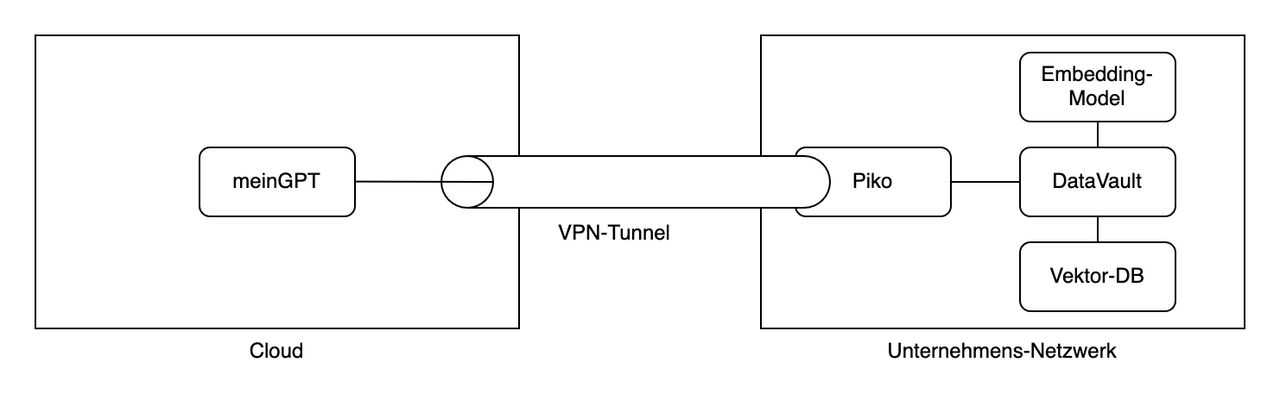
Outpost
The Outpost is the heart of a Outpost deployment. Its main task is to read data from various sources, process it and store it in the vector database, as well as answer search queries from MeinGPT. For this purpose, the data is converted into vectors using a special AI model, the embedding model, which are stored in the vector database. This allows efficient search for semantically similar text passages across thousands of documents.
The Outpost ships as a desktop application for Windows, macOS (Apple Silicon) and Linux — a download you get from MeinGPT. Server, vector database and embedding model are contained in it; there is nothing else to install.
Attention
Earlier versions shipped as a set of containers. We no longer publish that route — a new Outpost cannot be set up that way. If you still run such an installation, migration describes what the move involves; get in touch at enterprise@meingpt.com and we will do it together with you.
Vector Database
The vector database stores the vectors created by the embedding model together with the corresponding text chunks, and answers the similarity search.
Which database runs depends on the type of deployment:
- Outpost application for Windows, macOS and Linux: SQLite for the metadata, LanceDB for the vectors. Both run inside the Outpost process itself and live as files on disk. They are contained in the installer — no separate database service is installed or operated.
- Server deployments — the earlier generation and the cloud we operate: PostgreSQL with the VectorChord extension. Metadata and vectors live in the same database there.
In both cases a search request combines vector search with a keyword search (BM25), and every request is scoped to exactly one data pool.
Embedding Model
The embedding model is an AI model that converts text into mathematical vectors (embeddings). These vectors represent the meaning of the text in a high-dimensional space, so that semantically similar texts also generate similar vectors.
The quality of the embedding model has a direct impact on the quality of search results:
- The better the model, the better it understands the meaning of the texts
- The more dimensions the vectors have, the more accurately meaning nuances can be represented
- The larger the model, the more computing power is required
The Outpost uses exactly one embedding model for this: multilingual E5 (intfloat/multilingual-e5-small). It runs locally inside the Outpost process, with no internet connection required. There is no setting to choose a different model or an external provider.