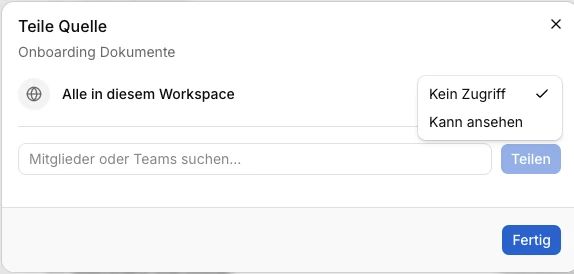
When you adopt a reported folder under Settings → Outposts → Manage → Shares with Use as source, the new data source is at first visible only to workspace admins. Nobody else finds it, not even through an assistant.
Admins see every data source
Workspace admins have access to every data source, regardless of sharing. So
check whether a share works with an account that does not have the admin role.
Only workspace admins can share. You reach the sharing dialog in two places:
on the Outpost card under Settings → Outposts, via Access in the data source's row
on the data source's page, in the Teams tab, via Manage access
You share the data source with:
Everyone in this workspace
individual members
teams — all current members of the team, including people who join later
There is one level: Can view. Whoever has it finds the documents in search and chat. Only an admin can change or pass on sharing. Remove access takes a share back immediately.
An assistant cannot be given access — only people and teams can. If you attach a data source to an assistant as knowledge, every use applies the sharing of the person who is chatting:
If they have access, the assistant searches the data source.
If they do not, the assistant leaves the data source out without any notice and answers without those documents.
So share the data source with everyone who should use the assistant. In chat, each person can only attach data sources that are shared with them. Citations and downloads also check sharing on every call.
How much a folder releases is set on the machine: in the Outpost under Shares → folder → Data access, section Data retrieval.
In the Outpost
Shown in MeinGPT
What is released
Extracted text only (default)
Text only
Matching passages, file name and the full text of the document
Text and original files
Original files
Additionally the original file, for example to open it from a citation
The level cannot be changed in MeinGPT; it is only displayed there. Background: Security.
In the same tab, under Source folder, you set whether MeinGPT may only read files in the folder (Read only, default) or also create, edit, move and delete them (Read and write source files). Writing is limited to text files up to 48 KB (such as .txt, .md, .csv, .json, .xml, .yaml) and only possible for people the data source is shared with.
If nothing should leave for a while, choose Pause release from the Outpost card's menu. The machine keeps indexing; search and chat get nothing from this Outpost until you choose Resume release.
Without this feature: whoever may see the data source finds everything in it — NTFS, Active Directory and file permissions are not carried over. Your split into data sources is then your permission model.
With Apply Windows permissions, access additionally follows each individual person's NTFS permissions. This applies to search, opening originals and write access.
In the Outpost under Shares → folder → Data access, section
User-specific access, choose Apply Windows permissions instead of
Same access for everyone. Once the beta is enabled, newly shared folders
already start in this mode; existing folders stay as they are.
Map people to Windows accounts
Configure folder permissions opens the Folder permission center. It
lists every person in the workspace with their Windows account. For people
who sign in through Entra ID, the Outpost suggests the matching account —
you confirm the suggestions. You map everyone else manually, for example to
CONTOSO\alexander.taylor.
Check with one file
Under Test access rights, enter the path of an indexed file and see for
one person whether searching, opening and writing are allowed — and whether
an Outpost policy or Windows blocks it.
No mapping, no access. Anyone without a mapped Windows account gets nothing from this folder — workspace admins included. The permission center lists such a person as Access unavailable.
Requests not made on behalf of a person get nothing from such folders either.
During the first read, the folder shows Preparing permissions; until then it is not searched.
Permission changes are checked directly against Windows every time something is released. If you remove someone's NTFS permission on a file, that person no longer gets it from that moment on.
Sharing in MeinGPT still applies. Windows permissions narrow access within a data source; they never extend it. Anyone who may not see the data source in MeinGPT finds nothing, even with NTFS permissions.
Services you connect through an Outpost in the services preview follow the same pattern: after they are created, only an admin sees them. You share them on the Outpost card via Access (dialog Share Service) with everyone, members or teams. Whether a database may only be read or also written is set on the machine.