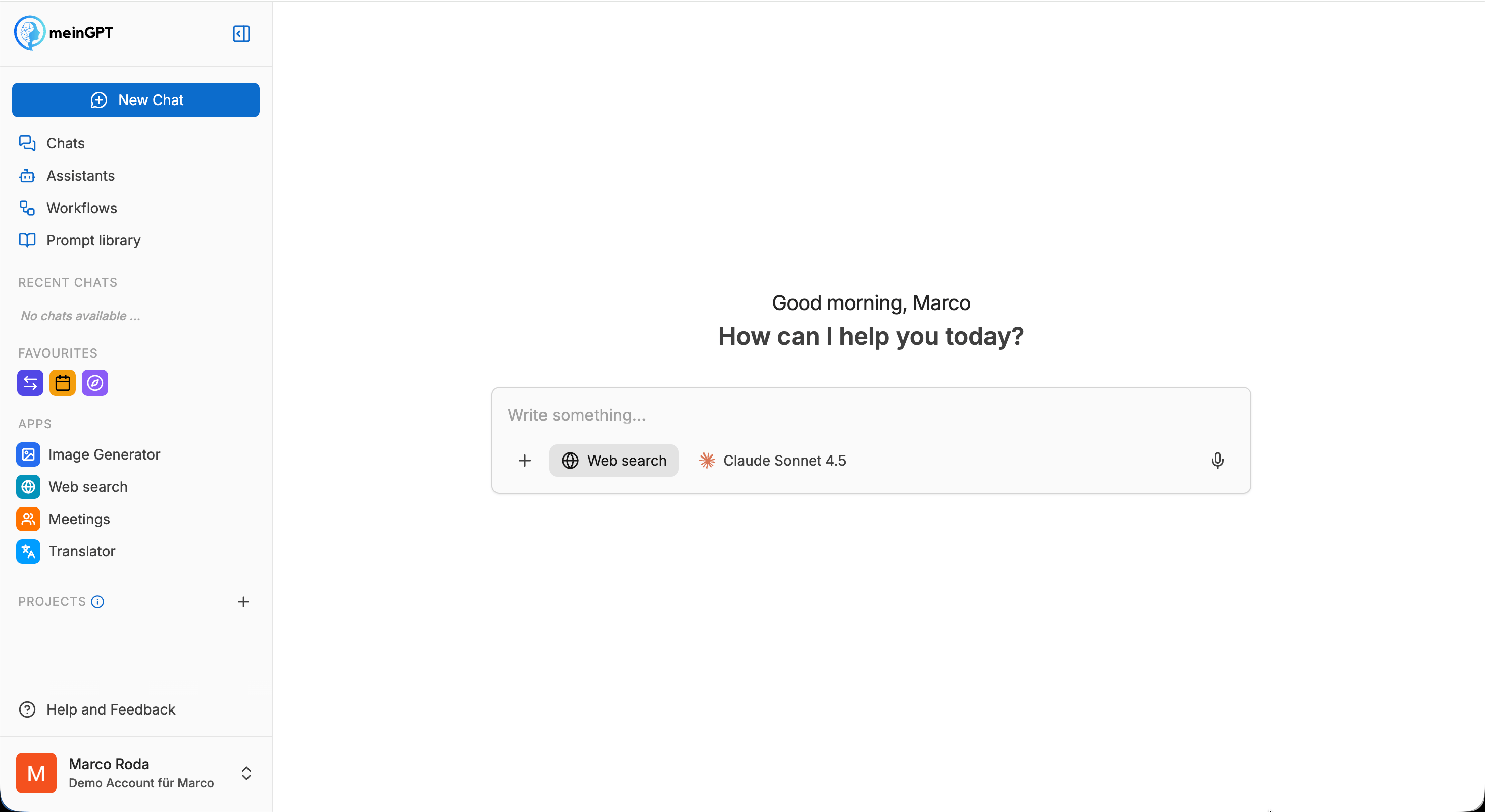
In today's digital business world, integrating powerful AI models into existing workflows is no longer just a competitive advantage — it's increasingly a necessity. Combining Google Vertex AI (Gemini) with meinGPT Workflows gives German-speaking companies a particularly powerful pairing – bringing together Google's highly advanced AI models with a GDPR-compliant workflow platform hosted in Europe.
This integration lets businesses harness Gemini's multimodal capabilities in a secure, data-protection-compliant environment, automating AI-driven processes that can handle text, images, video and other media formats – all in line with European data protection standards.
Why integrate Google Vertex AI (Gemini) with meinGPT?
Google Vertex AI (Gemini) is a powerful AI platform that lets you send chat prompts to Gemini models and receive responses, process multiple input types simultaneously (image, video, audio and documents), and benefit from an impressive context window of 2,000,000 tokens. The Gemini models offer built-in multimodality and advanced reasoning capabilities.
Integrating Google Vertex AI (Gemini) with meinGPT Workflows creates synergy that adds value to both platforms:
| Functional area | What Google Vertex AI (Gemini) offers | What meinGPT adds | Combined value |
|---|---|---|---|
| Multimodal AI | Processing of different modalities such as text, audio, video and more in a single prompt | GDPR-compliant processing and workflow integration | Legally sound multimodal AI workflows for European businesses |
| Model access | Access to over 200 enterprise-ready models, including Gemini, Claude 3.7 Sonnet, Llama 4 and more | Structured workflow management with different models | Using the optimal model for each individual workflow step |
| Automation | Tools for building and deploying AI agents | Integration with Make (formerly Integromat) for 1,000+ app connections | Comprehensive end-to-end automation with AI at the centre |
| Data protection | Cloud-based AI services with Google-grade security | Platform hosted in Europe with GDPR compliance | Maximum security and compliance for sensitive enterprise applications |
Extended possibilities through combining both technologies
Integrating Google Vertex AI (Gemini) into meinGPT Workflows opens up new possibilities for businesses:
- Advanced multimodal processing: Gemini enables text generation, image and video analysis for improved content creation, as well as the application of function-calling techniques. Within meinGPT Workflows, these capabilities can be embedded into structured processes.
- Enhanced analytical capabilities: Vertex AI provides access to the latest Gemini models, which can understand virtually any input, combine different types of information, and generate almost any output. This can be used within meinGPT Workflows for comprehensive data analysis.
- Strengthening company knowledge with AI: The integration makes it possible to combine the company knowledge stored in the meinGPT Data Vault with Gemini's advanced processing capabilities.
About meinGPT – the GDPR-compliant AI platform
meinGPT is an AI platform specifically optimised for German and European businesses, offering GDPR-compliant access to state-of-the-art AI technologies. As a central platform for all AI applications, meinGPT brings together various models and functions in a secure environment hosted in Europe.
The platform encompasses a wide range of AI tools for different application areas – from text generation and meeting management through to image and video production. One particularly valuable feature is its customisable workflows, which let you automate recurring tasks and build AI-driven processes.
The combination of GDPR compliance, versatile AI functionality and a user-friendly interface makes meinGPT the ideal solution for companies wanting to harness the benefits of artificial intelligence without compromising on data protection.
Key use cases: Google Vertex AI (Gemini) and meinGPT in action
Multimedia content analysis and creation
The challenge: Companies frequently need to efficiently analyse large volumes of mixed media content (text, images, video) and use it to create new, consistent content.
The solution with Google Vertex AI (Gemini) + meinGPT: An integrated workflow could be triggered by a Make trigger that detects new media files in a storage location (e.g. Google Drive or Dropbox). These files are passed to a meinGPT workflow, which:
- Forwards the files to Gemini via the Google Vertex AI API, with variables such as
{{Analyseziel}}(analysis goal) and{{Ausgabeformat}}(output format) controlling the process. - Gemini processes the different media types simultaneously – text, images, video and documents – and generates a comprehensive analysis.
- The meinGPT workflow structures these results according to the defined specifications and uses them to create new content such as summaries, reports or marketing copy.
- The finished content is automatically exported to CMS systems, social media or other target platforms.
The key benefit: Combining Gemini's ability to generate text from visual media with meinGPT's structured workflows enables highly automated media analysis and content creation that would otherwise require enormous manual resources.
Document processing with intelligent extraction
The challenge: Processing structured and unstructured documents (such as contracts, invoices, forms) is time-consuming and error-prone.
The solution with Google Vertex AI (Gemini) + meinGPT: An automated workflow can include the following steps:
- Documents are received by email or via a portal and forwarded to meinGPT through Make.
- A meinGPT workflow with access to the Data Vault (which contains company-specific document templates and rules) sends the documents to Google Vertex AI.
- Gemini analyses the documents and extracts the relevant information, taking into account variables such as
{{Dokumenttyp}}(document type) and{{Extraktionskriterien}}(extraction criteria). - The workflow compares the extracted data against internal specifications and carries out different follow-up steps depending on the result.
- The processed data is automatically fed into enterprise systems such as CRM, ERP or databases.
The key benefit: Combining Gemini's advanced document analysis with meinGPT's workflow capabilities drastically reduces manual document processing and minimises errors.
Multilingual customer service assistant
The challenge: International companies need to handle customer enquiries in different languages efficiently and consistently.
The solution with Google Vertex AI (Gemini) + meinGPT: An integrated workflow could look like this:
- Customer enquiries from various channels (email, chat, social media) are collected via Make and forwarded to meinGPT.
- The meinGPT workflow first categorises the enquiries and then passes them to Gemini with specific variables such as
{{Sprache}}(language),{{Thema}}(topic) and{{Priorität}}(priority). - Gemini can respond in numerous languages, making it ideal for multilingual customer interactions.
- The responses are checked within the meinGPT workflow against company guidelines and adjusted where necessary.
- The finished responses are sent back to the relevant output channels via Make.
The key benefit: This approach enables consistent, multilingual customer service with fast response times, without the need for specialised staff for every language.
AI-driven product development and market research
The challenge: Product development teams need timely market insights and creative ideas in order to develop competitive products.
The solution with Google Vertex AI (Gemini) + meinGPT: An integrated market research and ideation workflow could run as follows:
- Initial product concepts or market questions are captured in a meinGPT workflow.
- The workflow sends targeted research queries to Gemini, using variables such as
{{Produktkategorie}}(product category),{{Zielmarkt}}(target market) and{{Wettbewerbsparameter}}(competitive parameters). - Vertex AI Search supports this with AI, natural language processing and large language models (LLMs) that deliver highly relevant search results and understand user intent.
- The results are structured within meinGPT and enriched with internal company knowledge from the Data Vault.
- In a second workflow step, Gemini generates creative product ideas based on the market insights.
- The final proposals are automatically transferred into project management tools or presentations for decision-makers.
The key benefit: Combining Gemini's research and creative capabilities with meinGPT's structured workflows significantly speeds up market research and ideation.
| Use case | Complexity level | Setup time | Maintenance effort | Ideal for |
|---|---|---|---|---|
| Multimedia content analysis | Medium | Medium | Low | Marketing, content teams |
| Document processing | High | High | Medium | Legal, finance and administrative departments |
| Multilingual customer service | Medium | Medium | Low | International companies with a global customer base |
| Product development | Low | Low | Minimal | Innovation and development teams |
Setting up your Google Vertex AI (Gemini) and meinGPT integration
Integrating Google Vertex AI (Gemini) with meinGPT Workflows can be done in several ways, depending on your specific requirements:
Integration options
The Vertex AI API can be used via REST, gRPC, or one of the provided client libraries (built on gRPC). Google offers client libraries for many common programming languages, which is the recommended route if your preferred programming language is supported.
The most common integration methods with meinGPT are:
| Integration type | Use case | Advantages | Setup effort | Recommended for |
|---|---|---|---|---|
| Make (formerly Integromat) | Process automation, data processing with AI pipelines, real-time predictions with event triggers | No-code solution, visual process design | Low | Business analysts, non-technical users |
| Direct API integration | Building custom applications with Gemini in Vertex AI | Maximum flexibility, low latency | Medium | Developers, technically skilled teams |
| Firebase SDK | Mobile and web apps accessing the Vertex AI Gemini API or Imagen API directly | Security options against unauthorised clients | Medium | Mobile and web developers |
For most users, integration via Make is the easiest way to get started, since no programming knowledge is required.
Basic setup steps
- Set up Google Cloud: Set up your Google Cloud project and enable the Vertex AI API. If you're new to Google Cloud, create an account to evaluate how the products work in real-world scenarios. New customers also receive $300 in free credits to test and deploy workloads.
- Create a meinGPT workflow:
- In meinGPT, create a workflow prepared for external API calls
- Define the required variables and document inputs
- Select the appropriate model for each workflow step
- Configure the Make integration (recommended route):
- Connect your meinGPT account to Make
- Create a new scenario in Make
- Add a Google Vertex AI module and a meinGPT module
- Configure the data exchange between the systems
For detailed information on the integration, see the meinGPT integration documentation.
Getting maximum value: tips for your Google Vertex AI (Gemini)-meinGPT workflows
To make the most of your integrated workflows, keep the following tips in mind:
1. Optimise model selection
Choose the right Gemini models for your specific tasks:
- Gemini Pro: Ideal for complex reasoning, analysis and summarisation of large volumes of information, sophisticated cross-modal reasoning, and problem-solving with complex codebases.
- Gemini Flash: Optimised for speed and efficiency, with response times under one second, high throughput and more cost-effective processing for a range of tasks.
In meinGPT, you can select the appropriate model for each workflow step to achieve the best results.
2. Effective prompt design
- Use meinGPT variables (e.g.
{{Variable}}) for dynamic prompts - Structure complex tasks into several sequential workflow steps
- Use clear, precise instructions and provide context
- Experiment with different prompts and measure the results
3. Use the Data Vault for context
The Google Vertex AI API offers a robust suite of AI tools provided by Google Cloud for building, deploying and scaling machine learning models. Combine these capabilities with the meinGPT Data Vault to:
- Incorporate company-specific information into AI generations
- Ensure consistent responses based on internal guidelines
- Improve the relevance and accuracy of AI-generated content
4. Configure document output efficiently
Use meinGPT's versatile document output options to format the results of your Gemini-based workflows optimally:
5. Iterative improvement and monitoring
- Start with simple workflows and expand them step by step
- Monitor performance and results regularly
- Optimise prompts and workflow steps based on the results
- Use Make.com for detailed monitoring of your integrated workflows
Frequently asked questions about the Google Vertex AI (Gemini)-meinGPT integration
Question: What advantages does integrating Google Vertex AI (Gemini) with meinGPT offer over using Gemini directly?
Answer: The integration combines Gemini's advanced AI capabilities with meinGPT's GDPR compliance, structured workflows and integration with over 1,000 applications via Make.com. This enables secure, automated and enterprise-compliant AI processes.
Question: Is the integration of Google Vertex AI (Gemini) with meinGPT GDPR-compliant?
Answer: Yes, meinGPT is a GDPR-compliant platform hosted in Europe. Data processing follows European data protection standards, making the integration particularly attractive for European businesses.
Question: What are the technical requirements for the integration?
Answer: You need a Google Cloud account with the Vertex AI API enabled and appropriate authentication. The Vertex AI Gemini API uses Identity and Access Management instead of API keys for access control. You'll also need a meinGPT account.
Question: Can I combine different AI models within a single workflow?
Answer: Yes, in meinGPT you can select a different model for each workflow step – from Gemini to Claude and other models supported by meinGPT – to make optimal use of the strengths of different AI models.
Question: How does the integration support multimodal data processing?
Answer: Gemini models work with multimodal prompt requests, meaning you can use more than one modality or input type within a single prompt. Modalities can include text, audio, video and more. These can be integrated into meinGPT workflows.
Question: Are there example workflows to get started with?
Answer: Yes, both Google and meinGPT provide example workflows and guides. You can find these in the meinGPT documentation and in the Google Cloud Generative AI Repository.
Conclusion
Integrating Google Vertex AI (Gemini) with meinGPT Workflows gives businesses a powerful combination of advanced AI capabilities and GDPR-compliant, structured processes. This synergy makes it possible to harness complex multimodal data processing within secure, automated workflows – from document analysis and content generation to multilingual customer service.
For European businesses in particular, this integration offers an ideal way to harness Gemini's advanced capabilities within a data-protection-compliant environment. The flexibility in model selection, the extensive integration options via Make, and the structured workflow management make this combination a valuable tool for companies looking to optimise their processes with AI.
Take the next step with meinGPT
Ready to experience the power of Google Vertex AI (Gemini) in your own meinGPT workflows? Here are your next steps:
- Discover meinGPT and learn more about the platform
- Book a personal demo to experience the integration live
- View case studies to discover successful implementations
- Contact the meinGPT team with questions about the integration
- Learn about meinGPT's pricing plans
Boost the efficiency of your processes and unlock the full potential of AI with the combination of Google Vertex AI (Gemini) and meinGPT – GDPR-compliant, secure and tailored to your business needs.
Sources
- Overview of Generative AI on Vertex AI | Google Cloud
- Quickstart: Generate text using the Vertex AI Gemini API | Generative AI on Vertex AI | Google Cloud
- Generate content with the Vertex AI Gemini API | Generative AI on Vertex AI | Google Cloud
- Gemini API using Vertex AI in Firebase - Google
- Get started with the Gemini API using the Vertex AI in Firebase SDKs | Vertex AI in Firebase
- Explore Generative AI with the Gemini API in Vertex AI | Google Cloud Skills Boost
- Google models | Generative AI on Vertex AI | Google Cloud
- Vertex AI Platform | Google Cloud
- Vertex AI Agent Engine overview | Generative AI on Vertex AI | Google Cloud
- Gemini 2.5 Pro | Generative AI on Vertex AI | Google Cloud
- Vertex AI API | Google Cloud
- Vertex AI documentation | Google Cloud
- API usage overview | Vertex AI | Google Cloud
- Introduction to Vertex AI Search | AI Applications | Google Cloud
- Vertex AI API – Marketplace
- Google Vertex AI | API Integration | Vantage
- Vertex AI Enterprise Platform | Google Cloud
- Vertex AI Platform | Google Cloud
- Google Vertex AI API Integrations - Pipedream
- GitHub - googleapis/python-aiplatform: A Python SDK for Vertex AI, a fully managed, end-to-end platform for data science and machine learning.
- Generate content with the Vertex AI Gemini API | Generative AI on Vertex AI | Google Cloud
- Get started with the Gemini API using the Vertex AI in Firebase SDKs | Vertex AI in Firebase
- Quickstart: Generate text using the Vertex AI Gemini API | Generative AI on Vertex AI | Google Cloud
- Gemini API using Vertex AI in Firebase - Google
- Develop GenAI Apps with Gemini and Streamlit - Getting Started with the Gemini API in Vertex AI with cURL | Google Cloud Skills Boost
- Overview of Generative AI on Vertex AI | Google Cloud
- Explore Generative AI with the Gemini API in Vertex AI | Google Cloud Skills Boost
- Getting Started with the Gemini API in Vertex AI | Google Cloud Skills Boost
- node.js - Utilizing Gemini: Through Vertex AI or through Google/generative-ai? - Stack Overflow
- Getting Started with the Gemini API in Vertex AI