ChatGPT Enterprise licence: cost, licence models & how to choose (2026)
What a ChatGPT Enterprise licence is, how the tiers (Free, Plus, Team, Enterprise) differ, where enterprise AI cost really comes from, and which GDPR-compliant European option publishes transparent prices — with cost drivers, a procurement checklist and an example prompt.
by MeinGPT Team/August 4, 2023/7 min read
Share
from €29
Self-service: per user/month including usage credit (MeinGPT)
€20 → €5
Guided rollout: licence tier per user by volume
ISO 27001
EU operation, no training on inputs, penetration test 2025
A ChatGPT Enterprise licence is the tier built for whole organisations: central administration, single sign-on, a longer context window, and the contractual assurance that inputs are not used for training. Unlike the individual subscriptions, OpenAI publishes no list price for it — the price is an individual quote based on user count, term and features. This article explains how the tiers differ, where enterprise AI cost really comes from, what to check on data protection, and which GDPR-compliant European option with transparent pricing exists as an alternative.
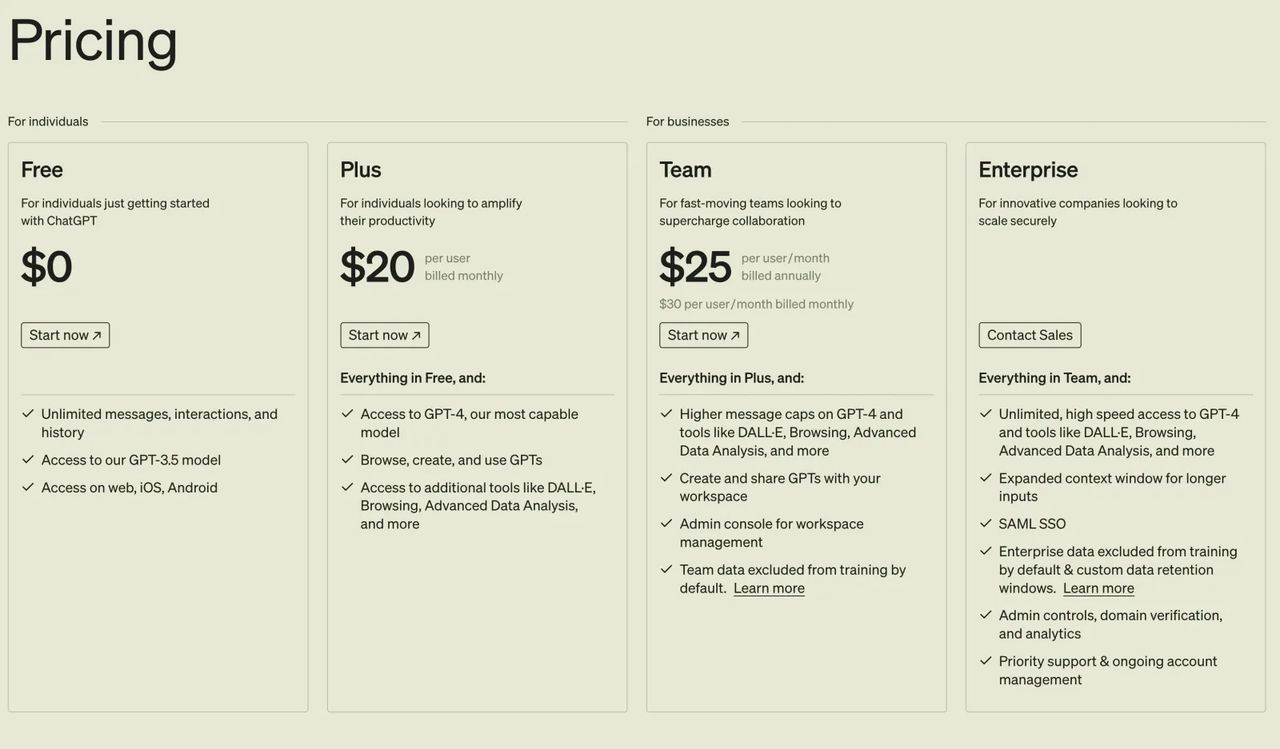
ChatGPT comes in several tiers that differ less in the chat window than in administration, capacity and data protection. Which tier fits depends on whether you are equipping one person, a small team or a whole organisation.
Free — the no-cost entry point for individuals trying it out, with access to a base model and limits on usage and features.
Plus — a fixed monthly individual subscription per user with more capacity, higher usage limits and access to the newer models. Suitable for individual power users, but with no central administration.
Team — for small groups: several users under shared administration, with the assurance that inputs are not used for training. The pragmatic entry point for smaller companies.
Enterprise — the organisation-wide tier with admin console, single sign-on (SSO), roles and permissions, a longer context window, usage analytics and extended security and compliance features. Priced individually, usually with a minimum user count and minimum term.
Remember: Free and Plus are individual subscriptions with no central control. Team and Enterprise are organisational licences — the difference lies in administration, SSO, data-protection assurances and price structure, not in the language model alone.
One person, occasional use: Free or Plus is enough. Central administration is not needed.
A small team (a few to a few dozen people): Team offers shared administration and a data-protection assurance at low administrative overhead.
A whole organisation with compliance requirements: Enterprise, where admin control, SSO, audit evidence and dependable data-protection assurances are required.
What decides is less the headcount than whether central governance and demonstrable data protection are needed. Anyone planning company-wide access will find the practical steps in setting up a ChatGPT business account.
The per-seat price is the most visible but rarely the largest block. Anyone costing an AI licence for a company should consider five drivers separately:
Seats / licences. The base cost per user per month, often with a minimum user count and minimum term. In tiered models, the per-seat price falls as the user count rises.
Consumption / usage. Actual model usage is frequently billed on consumption — through tokens (via the API) or through a usage credit. Intensive use, long documents and compute-heavy models drive this line.
Setup & integration. One-off effort for configuration, SSO, connecting internal systems and standing up the first use cases.
Governance & operations. Ongoing effort for roles, permissions, approvals, access reviews and maintaining connected data sources.
Enablement / training. The most frequently underestimated line — and simultaneously the biggest lever on the benefit.
The largest hidden cost block is unused licences. Without enablement, experience shows only a fraction of the workforce uses AI regularly. Every paid but unused licence lowers the return on the whole investment. The decisive metric is therefore not the seat price but actual daily usage.
Anyone needing predictable, published prices rather than an individual quote — and wanting EU operation secured — will find an alternative in a German platform. MeinGPT bundles several leading language models behind a GDPR-compliant interface and publishes its prices:
Self-service (Business): from €29 per user per month, including €9 usage credit per seat, paid by card. The fast, transparent entry point for smaller teams.
Guided rollout: a monthly platform base fee of €500 plus a licence tiered by user count and a shared usage credit. The tiering lowers the per-seat price as the user count rises.
One-off setup: depending on scope, €1,500 to €3,500 for onboarding and setup.
Pilot programme: the typical entry into a guided rollout, from €9,000 over three months.
The tiered licence for a guided rollout:
Users (tier)
Licence per user / month
up to 50
€20
51 – 100
€15
101 – 250
€10
251 – 500
€7
500+
€5
The tiering works like tax brackets: each group of users is charged at its own tier price. One central difference from many enterprise models: AI usage runs on shared credit rather than a flat rate. The company therefore pays for actual usage, and cost scales traceably with it instead of flatly per head. Current prices and a calculator are at meingpt.com/en/pricing.
For use in the EU, price is only half the decision — the other half is data protection. These points should be contractually assured and independently evidenced:
Operation and data processing in the EU — where do processing and storage actually happen?
A data processing agreement (DPA) as standard — for ISO 27001 operators the DPA is part of the contractual requirements (ISO clause A.5.31).
No training on company inputs — contractually excluded.
Independent evidence — an ISO 27001 certification and regular penetration tests rather than mere self-declaration.
Central permission management, SSO, least-privilege access and logging for auditable operation.
MeinGPT is operated by SelectCode GmbH, which is ISO 27001 certified and last had its security examined by an independent penetration test (SySS) in 2025. Access runs through central user and permission management with SSO; access to internal systems is limited by least-privilege rights, logged, and subject to regular review. Evidence and policies are available through the Trust Center.
Structuring quotes and letters. Turn bullet points into a cleanly structured, binding quote — professional review and approval stay with the person.
Summarising contracts and long documents. Pull key points, deadlines and risks out of lengthy PDFs, so departments can review selectively rather than read exhaustively.
Knowledge research with sources. Ask questions of connected internal documents and get answers backed by sources — rather than general internet information.
Example prompt (drafting a quote):
"Turn these bullet points into a structured quote for a new customer: service = maintenance contract for a conveyor system, 24-month term, 4 services per year, 24 h response time, price €1,850 per month. Tone: factual and binding. Structure: scope of service, terms, next steps. Mark every place where information is still missing with '[please check]'."
Expected result (abridged):
Scope of service — maintenance of the conveyor system incl. 4 scheduled services/year, 24 h response time for faults, documentation per visit.
Terms — 24-month term, monthly flat fee €1,850, renewal [please check: notice period], spare parts [please check: included/separate].
Next steps — quote review, proposed date for the first service, countersignature.
The result is an auditable draft in minutes rather than half an hour — responsibility for the content stays with the person accountable for it.
The ChatGPT Enterprise licence is the right tier for organisations needing central administration, SSO and dependable data-protection assurances — but it is calculated individually, without a public list price. What decides the return is not the seat price but the total cost across all five drivers, and above all actual usage. Anyone looking for predictable, published prices and secured EU operation should put a GDPR-compliant European platform such as MeinGPT (self-service from €29/user/month, guided rollout with a tiered licence) into the evaluation. Check every option against the procurement checklist above — and choose on objective criteria rather than instinct.
FAQ
Frequently asked questions
01What does a ChatGPT Enterprise licence cost?
There is no public list price for ChatGPT Enterprise. The price is calculated as an individual quote and depends on the number of users, contract term and the features required; a minimum user count and minimum term usually apply. Anyone needing predictable, transparent pricing will find an alternative in a German platform such as MeinGPT: self-service from €29 per user per month including usage credit, and a guided rollout with a tiered licence.
02What is the ChatGPT Enterprise licence?
ChatGPT Enterprise is the licence tier for organisations. It offers central user and permission management (admin console), single sign-on, a longer context window, extended security and compliance features, and the contractual assurance that inputs are not used to train the models. Unlike the individual subscriptions, it is built for enterprise-level administration and data protection.
03Which ChatGPT licence tiers exist and how do they differ?
There are four basic tiers: Free (no cost, for individuals trying it out), Plus (a fixed monthly individual subscription per user, more capacity and newer models), Team (for small groups with shared administration) and Enterprise (organisation-wide, with admin console, SSO, longer context and data-protection assurances, priced individually). Which tier fits depends on user count, administrative need and data-protection requirements.
04Who is ChatGPT Enterprise worth it for?
The Enterprise tier is worth it for organisations wanting to give many employees centrally managed, compliant access — with admin control, SSO and audit evidence. For individuals, Plus is enough; for small teams, the Team tier. What decides is less the headcount than whether central governance and dependable data-protection assurances are required.
05Where does the cost of enterprise AI really come from?
The per-seat licence price is only one part. Total cost consists of seats/licences, consumption (model usage, usually token- or credit-based), one-off setup and integration, ongoing governance, and enablement (training). The largest hidden cost block is unused licences: without enablement, often only a fraction of the workforce uses AI regularly — and the access you paid for evaporates.
06How is ChatGPT Enterprise billed?
Enterprise licences are usually agreed as an annual contract with a set number of users; the licence count can be adapted to demand. Model usage through the API is billed additionally on consumption. At MeinGPT, usage runs on shared credit that scales with actual use, which keeps cost predictable.
07Can ChatGPT Enterprise be used GDPR-compliantly?
ChatGPT Enterprise assures that company inputs are not used for training and offers enterprise-level security features. For GDPR-compliant use in the EU you should additionally check operation and data processing in the EU, a data processing agreement (DPA), and independent evidence. MeinGPT is operated in the EU by SelectCode GmbH, is ISO 27001 certified and has its security examined regularly by independent penetration tests.
Das MeinGPT-Team aus München baut die DSGVO-konforme KI-Plattform für Teams und Unternehmen in der EU – und teilt hier praxisnahe Einblicke aus echten KI-Einführungen.
Newsletter
Stay ahead on AI in the enterprise
Every 2 weeks: hands-on playbooks, product news and behind-the-scenes insights from MeinGPT. No spam, unsubscribe anytime.