AI cost per employee: what AI in the enterprise really costs
AI cost per employee: median €3.55/month, currently ~€6.50 since the premium models — and the top 10 % drive 78 % of the cost. Why usage is the smallest line in your TCO.
by MeinGPT Team/July 21, 2026/7 min read
Share
€3.55 → ~€6.50
Median usage per active user/month (12-month median, current figure since the premium models)
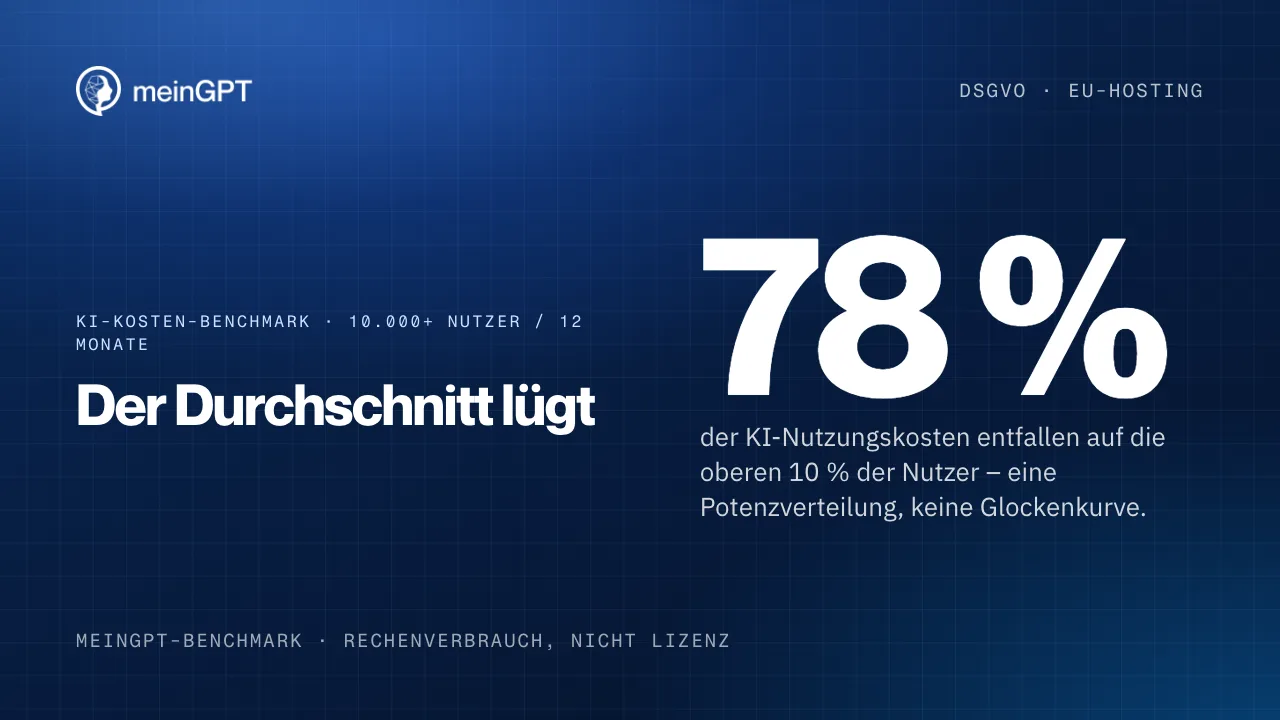
78 %
of usage cost comes from the top 10 % of users
~½ TCO
of an AI rollout is adoption, not licence
In the MeinGPT benchmark, AI costs a median of €3.55 per active user per month in usage (12-month median) — and since the premium models arrived (GPT-5.5, Claude Opus 4.8) the running median sits at ~€6.50. The average deceives twice over, because the top 10 percent of users drive roughly 78 percent of the cost. Ongoing usage is the smallest line of all: around half the total cost of ownership goes to adoption, not to the tool. [PRIMARY — MeinGPT benchmark, 10,000+ users / 12 months]
"What does AI actually cost us per head?" The question sounds harmless, and the answer that ends up on most management slides is wrong anyway. Not because anyone is fudging it — but because the average lies. Flatten AI cost per employee across all users and you get a tidy number that supports no decision at all.
In our own benchmark the median is €3.55 per active user per month. That sounds like petty cash. For roughly 90 percent of your people, it is. The problem is the other ten percent: they account for the lion's share of the cost. An average that presses both groups into one figure obscures exactly the structure a CFO or an IT lead has to manage.
And there is a second inconvenience. Ongoing consumption is the smallest line in an AI rollout. Half the TCO sits in something that appears on no quote. So let us look at where the money actually goes — and how you steer it instead of guessing.
Because AI usage follows a power distribution, not a bell curve. A small circle of power users drives most of the consumption while everyone else sends the occasional prompt. In the MeinGPT benchmark the top 10 percent of users drive around 78 percent of the cost — which is why the median (€3.55 over 12 months, currently ~€6.50 since the premium models) and the mean sit so far apart, and why the mean is worthless for planning.
The median is not a fixed value either: since the premium models came to market (GPT-5.5, Claude Opus 4.8) the running median has risen to ~€6.50 per active user [PRIMARY — MeinGPT benchmark]. That is still compute, not licence — the pricier premium models simply push the usage median up without changing the underlying pattern.
Data distribution
The average lies
Top 10 % of users90 % occasional users
Users
drive 78 % of the cost22 %
Usage cost
A small circle of power users carries most of the consumption, which is what makes the mean useless for planning. Median: €3.55 (12-month median) → currently ~€6.50 per active user/month since the premium models. [PRIMARY: MeinGPT benchmark]
Work it through once: if such a small circle drives most of the cost, then the average tells you neither where you could save nor where value is created. It only tells you that you have a number. That is the difference between "we spend X" and "we know what for".
It means the actual compute consumed by usage — what requests and generated text cost in processing — not the licence price. This is not hair-splitting: a flat per-seat price shifts the consumption risk, it does not remove it.
Pay a flat rate per head and your occasional users cross-subsidise the power users, while the consumption structure disappears from view entirely. Pay by consumption and you can see it — and steer it. Both models have their place. But you should know which question you are answering: "what am I paying?" or "what are we consuming?".
Three, not one: median, peak, and activation rate. The median (~€3.55/active user/month) shows the baseline for the majority, P90/P99 show where the budget actually sits, and the activation rate shows whether you are paying for usage or for dormant seats. Only together do the three produce a picture you can manage.
Median (~€3.55/active user/month in the benchmark): what the typical employee costs. Your baseline for the majority.
P90 / P99 (the top ten and top one percent): what the power users cost. This is where most of the budget sits — and usually the largest contribution to value.
Activation rate: how many of your licensed users actually use the AI. A licence for someone who never logs in is the most expensive line on the invoice, because it produces nothing in return.
The median shows the baseline, the peak shows where to look, the activation rate shows whether you are paying for usage at all. If you want to run those three numbers for your own workforce, the AI cost calculator takes headcount, activation rate and usage level and works out consumption and a TCO range.
Far more than the licence price. The total cost of ownership of an AI rollout has four blocks: adoption/enablement, integration & operations, governance & security, and ongoing usage. Compute — the block holding the €3.55 to €6.50 — is the smallest of them, and the visible licence price is merely its wrapper. According to Bitkom, 33 percent of companies say AI cost more than they expected [PRIMARY — Bitkom 2026]: the surprise is not in consumption, it is in the other three blocks.
That surprise is not a sticker shock on licences — those are known in advance. It is the bill for everything that was not on the quote.
actual consumption — this is where the €3.55 → ~€6.50 per user/month sits
The shares are directional: what is evidenced is the adoption block (~½ of TCO) from MeinGPT project experience and usage as the smallest block from the benchmark; the two middle blocks are illustrative, not measured benchmarks.
The licence price is the only line most quotes put a number on — yet it is just the invoice wrapper around the smallest block. The four real cost blocks, adoption above all, decide whether the project turns into value or into an expensive dormant seat. Plan for the licence alone and adoption will surprise you — which is how you end up in that 33 percent statistic.
Because a large share of total cost is not technology but people learning to use the technology. A common market estimate illustrates the order of magnitude: for a well-known Microsoft 365 Copilot offering at 100 employees, first-year cost lands roughly between €67,000 and €133,000, about half of it adoption and enablement [SECONDARY — market estimate].
That figure is a neutral order of magnitude, not a price comparison and not an evaluation — it only shows what the ratio of licence to adoption typically looks like. And that is the real point: the bottleneck is not the tool, it is whether your people actually use it. Adoption is the real cost driver — and simultaneously the lever for the return. A low licence figure without activation is therefore not a saving but burnt money: you are paying for access nobody redeems.
It depends on how you roll it out — and that is precisely what the benchmark says. Gartner puts the share of companies seeing significant ROI from generative AI at around 3 percent [PRIMARY-analyst — Gartner]. Forrester calculates 116 to 353 percent ROI over three years for well-executed cases [PRIMARY-analyst — Forrester]. Both are true: the same technology, executed differently.
Study
Finding on AI ROI
Gartner
Around 3 % of companies see significant ROI from generative AI. [PRIMARY-analyst]
Forrester
116–353 % ROI over three years where execution is good. [PRIMARY-analyst]
The contradiction is the insight: the spread between "barely worth it" and "massively worth it" is not decided by the tool but by the execution. The three percent and the 353 percent are frequently the same technology.
What does that mean for your planning? The difference between an AI project in the 3-percent group and one in the 353-percent group is rarely the licence. It is whether the four TCO blocks were thought through together — block four in particular. If you want to work the ROI honestly, put adoption cost on the cost side and usage value on the revenue side without flattering either. Otherwise you are modelling a phantom. That is exactly the calculation the AI ROI calculator performs: time saved, hourly rate and activation on one side, the full cost from the cost calculator on the other.
With three levers: measure per head, centralise usage, invest in adoption. Cost opacity is not a law of nature but a setup problem — with a central AI platform such as MeinGPT, "we spend something" turns into a budget you can manage. In order:
1. Measure per head, not in aggregate. Look at median, P90/P99 and activation rate separately. The peak is not a problem to be cut away — it is often your most valuable use cases. But you want to know it exists, and why.
2. Centralise usage and visibility. Ten scattered AI subscriptions across ten departments produce zero overview and duplicate cost. Through one central AI platform you see consumption, usage and data protection in one place — and can calculate per head at all. Without that visibility, every cost plan is a guess.
3. Invest in adoption, not against it. If half the TCO sits in enablement anyway, cutting training is the wrong economy. It lowers the invoice and the usage at the same time — and with it the return. The right lever is to direct adoption deliberately at the use cases that create real value.
Sounds like more work than "one number on a slide". It is. But it is the difference between an AI budget you can defend and one that surprises you next quarter.
Want to know what your numbers would look like? In a demo we show you how the per-seat view of consumption, activation and adoption works in practice — starting from your own usage profiles.
The average in AI cost per employee is not a lie by intent but by structure: it smooths a power distribution in which a small circle of power users carries most of the cost. Know only the mean and you plan blind. Know the median, the peak and the activation rate — and budget the four TCO blocks including adoption honestly — and you have a budget you can defend. Ongoing consumption is the smallest lever, adoption the largest.
If you want to know what your per-seat numbers look like and where your budget really goes, the fastest route is a concrete look at your usage profiles.
FAQ
Frequently asked questions
01What do AI tools cost per employee in a company?
In the MeinGPT benchmark the median is around €3.55 per active user per month of actual usage (12-month median). Since the premium models such as GPT-5.5 and Claude Opus 4.8 came to market, the running median sits at roughly €6.50 — still compute, not licence. The mean is higher because the top ten percent of users drive about 78 percent of the cost. For planning you need the median, the peaks and the activation rate, not an average.
02Does "cost" mean the licence price?
No. It means the actual compute consumed by usage, not the licence price. A flat per-seat licence shifts the consumption risk, it does not remove it. For an honest TCO view, report licence and consumption separately.
03Why is AI more expensive than expected?
Because most calculations only budget for the licence. According to Bitkom 2026, 33 percent of companies say AI cost more than they expected — and the surprise sits in integration, operations and above all adoption. Half the total cost of ownership typically falls on enablement, not on the tool.
04Is AI worth it at all if only 3 percent see significant ROI?
Gartner's 3 percent and Forrester's 116–353 percent over three years describe the same technology, executed differently. ROI is not decided by the tool but by whether adoption and use cases were planned alongside it. Roll out a licence alone and you end up nearer the 3 percent.
05How do I calculate the TCO of an AI rollout?
Budget four blocks instead of one: adoption/enablement, integration/operations, governance/security, and ongoing usage. Compute is often the smallest line — the visible licence price is merely its wrapper. Planning for that alone systematically understates the total, and misses that the adoption block is what decides the return.
The per-seat benchmark (median €3.55 over 12 months, currently ~€6.50 since the premium models GPT-5.5 and Claude Opus 4.8 came to market; concentration of 78 % of cost on the top 10 % of users) comes from anonymised MeinGPT usage data covering 10,000+ users over 12 months. External market figures are marked in the text: the share of surprised companies (33 %) per Bitkom (2026), the ROI ranges per Gartner and Forrester respectively, and the Microsoft 365 Copilot order of magnitude as a neutral market estimate (not a price comparison, not an evaluation). As of 7 August 2026.
KI-Expert:innen für den Mittelstand
MeinGPT Team
Das MeinGPT-Team aus München baut die DSGVO-konforme KI-Plattform für Teams und Unternehmen in der EU – und teilt hier praxisnahe Einblicke aus echten KI-Einführungen.
Newsletter
Stay ahead on AI in the enterprise
Every 2 weeks: hands-on playbooks, product news and behind-the-scenes insights from MeinGPT. No spam, unsubscribe anytime.